There is something almost magical about gathering around a fire with friends and family, roasting marshmallows, sharing stories, and soaking in that warm, flickering glow. If you have been thinking about adding a fire pit to your backyard, you are in great company. Fire pits have become one of the most popular outdoor upgrades for homeowners who want to get more use out of their outdoor spaces.
But here is the thing: walk into any home improvement store or scroll through options online, and you will quickly feel overwhelmed. Wood burning or propane? Round or square? In-ground or freestanding? The choices seem endless, especially if this is your first time buying one.
The good news is that choosing the right fire pit does not have to be complicated. Once you understand the basics, the decision becomes a lot more straightforward. In this post, we are breaking down everything a beginner needs to know, from fuel types and design options to safety tips and budget considerations. By the end, you will know exactly what to look for and feel confident picking the perfect fire pit for your space.
Why Fire Pits Are Worth the Investment
If you’ve been on the fence about adding a fire pit to your backyard, the numbers might surprise you. The global fire pits market was valued at USD 8.21 billion in 2025 and is projected to reach USD 15.59 billion by 2036, growing at a steady 6.0% annually. That kind of sustained growth doesn’t happen with passing trends. It reflects a genuine, lasting shift in how people think about their outdoor spaces.
A big part of that shift traces back to the staycation boom. Homeowners started investing seriously in their own backyards as a way to create the experiences they wanted closer to home. Fire pits moved from the “nice to have someday” list to a core part of backyard upgrades, right alongside outdoor kitchens and patio furniture. Today, buyers are treating them as long-term amenities, not seasonal accessories they pull out a few times a summer.
The practical value is real, too. A fire pit extends your usable outdoor hours well into the cooler evenings of spring and fall, giving you more time outside with family and guests. It naturally becomes a gathering spot, the kind that encourages people to linger a little longer.
Modern fire pit designs also go beyond basic heat. According to market analysis from Polaris Market Research, consumer demand for multi-functional outdoor features is actively broadening the category. Today’s options combine warmth, ambiance, and visual appeal in ways that genuinely add value to your outdoor living space year-round.
Fire Pit Fuel Types Explained
Not all fire pits run on the same fuel, and that difference matters more than most beginners expect. Here’s a quick breakdown of the five main fuel types you’ll encounter when shopping.
1. Gas Fire Pits Gas fire pits currently hold the largest slice of the market, accounting for 41.7% of product-type share in 2026. It’s easy to see why. You turn a knob, press a button, and you have a flame. There’s no wood to split, no ash to clean up, and no smoke drifting into your face. If convenience is your top priority and you have a natural gas line available, this category is worth a close look.
2. Wood-Burning Fire Pits Wood-burning fire pits are projected to reach USD 4.5 billion by 2030, which tells you there’s serious staying power here. Buyers love the authentic crackle, the real radiant heat, and the campfire feel that gas simply can’t replicate. Firewood is also widely available and affordable in most rural and suburban areas, making it a practical choice for many homeowners.
3. Propane Fire Pits Propane models offer a gas-style flame without needing a permanent gas line. That makes them a great fit for renters, apartment dwellers with a patio, or anyone who wants to move their fire pit around the yard or take it to different locations.
4. Charcoal Fire Pits Charcoal fire pits serve a niche crowd, mainly buyers who want one unit that handles both cooking and warmth. The tradeoff is real though; charcoal produces more ash, requires more cleanup, and isn’t the most relaxing option for a purely social gathering around the fire.
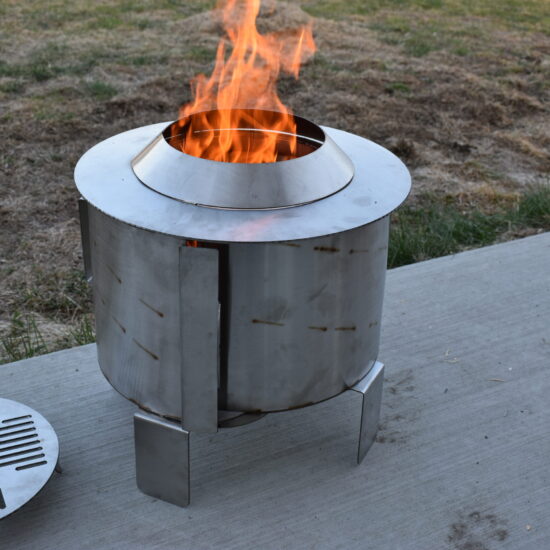
5. Smokeless Wood-Burning Fire Pits This is where the category gets genuinely interesting. Smokeless fire pits use a secondary combustion design that recirculates hot gases and reignites smoke particles before they escape. The result is a dramatically cleaner burn that still delivers the authentic wood-fire experience. It’s one of the fastest-growing segments in the market, and it’s exactly where our Revolve Smokeless Fire Pits come in. If you want the look and feel of a real wood fire without constantly repositioning yourself to avoid smoke, smokeless technology is a meaningful upgrade worth considering.
How Smokeless Fire Pits Actually Work
If you’ve ever sat around a traditional fire pit and spent more time dodging smoke than enjoying the fire, smokeless fire pits make a lot of sense. But how do they actually pull off a cleaner burn? The answer comes down to a clever bit of engineering called secondary combustion.
Here’s how it works. A standard fire pit lets air feed the fire from below, and whatever doesn’t fully combust floats upward as smoke. A smokeless fire pit adds a second step. The double-wall construction creates a channel between the inner and outer walls. As the fire heats up, that channel heats the air traveling through it. Vents near the top of the wall then release this superheated air back into the flame, reigniting unburned gases before they can escape as smoke. The result is a noticeably cleaner, more complete burn that makes a real difference when you’re sitting close to the fire with friends and family.
That said, “smokeless” is more of a description than a guarantee. The U.S. Forest Service’s Missoula Fire Sciences Laboratory has studied emissions from these units and confirmed that some smoke output still occurs. Under good conditions with dry, seasoned hardwood, the reduction is significant and easy to notice. Wet or green wood, though, produces far more smoke than secondary combustion can handle, so fuel quality matters a lot.
If you live in an area with HOA restrictions or local air quality rules around open fires, a smokeless design may offer more flexibility. The lower particulate output puts them in a different category than a traditional fire pit in many cases. That said, regulations vary widely by location, so it’s worth checking with your local fire authority or HOA board before you buy. As TIKI Brand explains in their buyer’s guide, understanding what you’re getting helps you choose the right fire pit for your specific situation.
Fire Pit Designs and Form Factors
Not all fire pits look the same, and the design you choose will shape how you use it, where you put it, and how much you enjoy it season after season. Here’s a look at the four main form factors you’ll encounter while shopping.
1. Bowl and Ring-Style Fire Pits Bowl and ring designs are the most recognized fire pit form on the market, holding a 36.9% product-form share in 2026. Their circular, open shape makes it easy to pull seating from any direction, which is a big reason they work so well in open backyards and on patios with flexible layouts. They come in wood-burning and gas configurations across a wide range of price points, making them one of the most accessible options for first-time buyers.
2. Fire Pit Tables Fire tables blend a flat tabletop surface with a built-in burner, giving guests a place to set drinks and plates while still enjoying a live flame. These designs run almost exclusively on gas or propane, which keeps the operation clean and simple. They are a natural fit for patio dining setups where functionality and ambiance need to coexist.
3. Portable Fire Pits Portable fire pits are built for movement. They are compact, lightweight, and designed to travel with you to campsites, tailgating events, or a different corner of your own yard. If you want heat without committing to a permanent installation, this format is worth a close look.
4. Built-In and In-Ground Fire Pits Built-in fire pits are constructed directly into your landscape using stone, concrete, or masonry. They offer the most custom aesthetic of any option, but they also carry the highest cost and require the most planning, including potential permitting depending on your municipality.
The most important question to ask before shopping is simply this: where will you use it most, and how often do you need to move it? Your answer will point you toward the right form factor faster than any spec sheet.
Key Buying Criteria: What to Evaluate Before You Purchase
Once you know which fire pit style and fuel type appeals to you, it’s time to get practical. Here are five criteria worth evaluating before you make a final decision.
1. Material and Build Quality
This is the factor most buyers underestimate until their fire pit starts rusting or warping after a season or two. Heavy-gauge steel holds up through repeated heat cycles, rain, and outdoor exposure in a way that thin-walled alternatives simply don’t. Pay attention to the finish as well; a quality powder coat or high-temp paint acts as a second layer of protection against corrosion. If a price seems surprisingly low, thinner materials are usually the reason.
2. Size and Capacity
Bigger isn’t always better, but undersizing is a common mistake. A 24-inch pit works well for two to four people, while groups of six or more will feel cramped around anything smaller than 36 inches. Larger diameter models also produce more radiant heat, which matters on cool evenings. Measure your patio or yard space before shopping so you’re not guessing at the point of purchase. This complete buyer’s guide to your first fire pit is a helpful resource for thinking through sizing alongside fuel and style.
3. Portability
If you want one fire pit that works in your backyard and travels to a campsite or hunting property, weight and packability belong on your checklist. Look for lighter steel construction, collapsible legs, and a carry bag or case. Cast-iron and stone options are beautiful but rarely practical for transport.
4. Ease of Use and Maintenance
A fire pit that’s a chore to light or clean will spend more time in your garage than your yard. Consider how ash is removed, whether a cover is included, and how straightforward the ignition process is for your chosen fuel type.
5. Local Regulations and HOA Rules
Before committing to a wood-burning or open-flame model, check your city or county burn ordinances and any HOA covenants that apply to your property. Many municipalities restrict or ban open wood-burning fires seasonally, and some HOA agreements limit open flames on patios entirely. Gas, propane, or smokeless designs are often still permitted where traditional wood burning is not.
Wood-Burning vs. Gas: Which Is Right for You?
Both gas and wood-burning fire pits have genuine strengths, and the right choice really comes down to how you plan to use yours.
Gas fire pits lead on convenience. Push-button ignition, adjustable flame height, and zero ash cleanup make them an easy sell for homeowners who want a cozy backyard atmosphere without any prep work. You turn a knob, you have a fire. You turn it off, you’re done. There’s nothing to haul, store, or sweep out the next morning. For busy households or frequent entertainers, that simplicity is hard to beat.
Wood-burning fire pits deliver a different kind of experience. The crackling sound, the shifting flame, the campfire warmth, these are the things that keep wood-burning firmly in the conversation despite gas holding roughly 41.7% of the global fire pit market by product type. Wood fires tend to produce more radiant heat, and there’s a hands-on quality to building and tending a fire that many people genuinely enjoy.
Fuel cost and availability are worth thinking through honestly. If you have a natural gas line already running to your home, a gas fire pit is a straightforward add-on. If you don’t, you’re managing propane tank refills and exchanges on an ongoing basis. In rural or suburban areas where firewood is inexpensive or available right on your property, wood is often the more practical and affordable fuel source.
Portability is another real difference. Gas setups depend on infrastructure; you need either a hard line or a tank. A portable wood-burning fire pit runs on fuel you can bring from home or gather on-site, making it a much more flexible option for camping trips or properties without utility hookups.
Smokeless wood-burning designs close the gap for smoke-sensitive buyers. If smoke is your main hesitation with wood, a smokeless fire pit gives you real flame and real heat with significantly reduced smoke output, a genuine middle ground worth considering. For a detailed side-by-side breakdown, this gas vs. wood fire pit comparison is a helpful reference as you narrow down your options.
Use Cases: Matching a Fire Pit to How You Actually Live
Not all fire pits fit every lifestyle, and picking the wrong one for how you actually use your outdoor space is one of the most common beginner mistakes. Here’s how to match the right fire pit to your situation.
1. Backyard and Patio Entertaining This is the most popular use case, and it comes with specific demands. You want a comfortable heat radius that warms guests without forcing them to sit uncomfortably close, a clean burn that keeps smoke from drifting into people’s faces, and a design that looks intentional alongside your patio furniture. A smokeless fire pit, like the Revolve from Flame Innovation, handles the smoke problem well, making it easier for guests to actually enjoy the fire rather than constantly shifting seats to avoid the plume.
2. Camping and Off-Grid Use Portability is everything here. You need something lightweight, compact when packed, and fueled by wood so you’re not dependent on propane tanks or fuel resupply in remote areas. A foldable or collapsible wood-burning fire pit gives you real flexibility when you’re far from a hardware store.
3. Hunting Camps and Wall-Tent Setups Extended rugged use calls for heavier-gauge steel and durable grates that hold up across a full season. Thin materials warp and deteriorate quickly under repeated high-heat burns.
4. Year-Round Use Materials matter significantly here. Steel, corten, and cast iron each respond differently to freeze-thaw cycles and prolonged moisture exposure. Choose a fire pit built with weather durability in mind if you plan to leave it outside through winter.
5. Urban Patios and Smaller Spaces Compact and portable wins here. You want something that doesn’t require permanent installation, stores easily, and fits a tighter footprint without overwhelming the space. Always check local burn ordinances before purchasing a wood-burning option for an urban setting.
Why American-Made Quality Matters When Buying a Fire Pit
In a market this size, with fire pits available at every price point and from manufacturers all over the world, knowing where your fire pit was made is a genuinely useful piece of information. American-made fire pits are held to domestic material and construction standards that are more transparent and easier to verify. When something goes wrong, or when you simply want to know what your fire pit is made of, a domestic manufacturer can actually answer that question. That kind of accountability is harder to get when a product travels through an overseas supply chain with multiple layers between the factory and your backyard.
Shorter supply chains also have real practical benefits. Domestic manufacturers can typically support warranty claims faster, keep replacement parts in stock more reliably, and offer customer service that knows the product firsthand. For a fire pit you plan to use season after season, that kind of post-sale support matters more than it might seem at the point of purchase.
At Flame Innovation, our Revolve Smokeless Fire Pits are designed and built in Post Falls, Idaho, with the same emphasis on durable construction and dependable performance that runs through everything we make. The Revolve is built for real-world use across a range of settings, from a backyard patio to a campsite to a hunting camp gathering spot, without turning into a maintenance project.
For buyers researching options like the fire pits made in the USA space, American-made quality isn’t just a feel-good label. It’s a practical filter in a crowded category, and it’s a reason to pay attention to where your fire pit actually comes from.
Finding the Fire Pit That Fits Your Life
The decision really comes down to three simple steps: start with fuel type, match the form factor to how you actually plan to use it, and then evaluate materials and build quality. Work through those three things honestly, and the right fire pit for your life becomes a lot easier to spot.
If you want the real wood-fire experience but smoke has always been the dealbreaker, smokeless wood-burning designs offer a genuinely practical middle ground. You get the crackling fire, the natural warmth, and the atmosphere, without constantly repositioning your chair or sending guests home smelling like a campfire.
Before you shop, think about where you’ll use it most. A backyard entertainer has different needs than someone who wants a portable option for camping trips. There is no single right answer, and your lifestyle should drive the choice.
If you’re looking for a well-built, American-made option that works for backyard gatherings, patio evenings, and camping, the Revolve Smokeless Fire Pit from Flame Innovation is worth a close look. Designed and built in Post Falls, Idaho, it’s built for real use, not just a showpiece. Explore the Revolve Smokeless Fire Pit and see if it fits your outdoor life.
Conclusion
Choosing the right fire pit comes down to a few key decisions: picking the fuel type that fits your lifestyle, selecting a design that suits your space, and staying within a budget that makes sense for you. Wood-burning pits offer that classic crackling experience, while propane and natural gas models deliver convenience and easy cleanup. Safety and placement matter just as much as aesthetics, so never skip those steps.
Now that you have a clear picture of what to look for, the hardest part is simply getting started. Measure your outdoor space, set your budget, and make a shortlist of features that matter most to you. Browse a few retailers with confidence, knowing exactly what questions to ask.
Your backyard fire pit is not just a purchase. It is the beginning of countless memorable evenings spent outdoors with the people who matter most.