Let’s be honest for a second: the world is getting a little too “smart” for its own good. We’ve got smart toasters, smart lightbulbs, and now, the wood stove industry is trying to sell you a “smart” stove. They’re packing these units with oxygen sensors, electric blowers, and fragile circuit boards, all in an attempt to chase EPA numbers and make the stove do the thinking for you.
Here’s the problem: heat kills electronics. It’s an elementary school science fact. When it’s negative twenty degrees outside in the middle of an Idaho blizzard and the power grid decides to take a nap, do you really want to be hovering over a diagnostic screen trying to figure out why “Error Code 404” is standing between your family and a warm house?
At Flame Innovation, we think that’s a load of nonsense. We build our stoves for people who value reliability over gadgets. We bet on mechanical engineering and heavy-duty Idaho steel because you can’t fix a fried motherboard when the roads are closed, but a well-designed air valve works every single time.
The Problem with the Electronic Push
The shift toward electronic wood stoves isn’t happening because consumers asked for it; it’s happening because it’s the “easy” way for manufacturers to meet tightening emissions standards. By using sensors to constantly tweak the airflow, they can force a clean burn.
But “easy” for the manufacturer usually means “headache” for the owner.
When you introduce electronics into a high-heat environment, you’re setting a countdown clock on that stove’s lifespan. Components warp, solder joints crack, and sensors soot up. We’ve always believed that a wood stove should be the most reliable tool in your shed. It’s your insurance policy against the world going sideways. That’s why we’ve spent years perfecting the physics of the burn so we don’t have to rely on a computer chip to keep things clean.
The Chinook: The 480lb Heavyweight Champion
If you’re looking to heat a full-sized home (up to 2,000 square feet) and you want it done with zero electricity, meet the Chinook.
This isn’t your average big-box store stove. The Chinook is a 480lb beast of American craftsmanship. When we talk about “thermal mass,” this is what we mean. That much steel holds onto heat long after the fire has died down, radiating warmth into your living room while you’re fast asleep.
The VCV System: Pure Mechanical Genius
How do we get a clean, EPA-compliant burn without sensors? We use our patented VCV (Variable Choked Venturi) system.
The VCV is a purely mechanical valve setup. It’s a precision-engineered air intake that manages the fuel-to-oxygen ratio based on how you set the manual controls. It creates a secondary combustion environment that burns the smoke before it ever hits your chimney. No wires, no plugs, just high-level physics doing the heavy lifting. It’s designed to give you a clean, mesmerizing fire that you don’t have to “babysit.”
The Steelhead: The Ultimate Cabin Companion
For those of you living in a cabin, a tiny home, or a workshop, you don’t need a 480lb monster. You need the Steelhead.
At 180 lbs, the Steelhead is the sweet spot of our lineup. It’s designed to heat spaces between 800 and 1,200 square feet, but it does a lot more than just sit there and look tough. We know that when you’re off-grid, every tool needs to pull double duty.
Cook, Heat, and Wash
The Steelhead features a massive 14×14 flat cooktop. This isn’t just for keeping a kettle warm; you can actually cook a full meal on this surface. But we didn’t stop there. One of the most popular upgrades for the Steelhead is our 10-gallon stainless steel water tank.
Imagine having ten gallons of hot water ready for dishes or a shower just because you’ve got a fire going. No propane, no electric water heater, just smart (but mechanical) design. It’s the ultimate survivalist’s dream.
The Caboose: Big Heat for Tiny Spaces
There is a growing movement of people moving into vans, schoolies, and ultra-tiny homes. The problem? Most wood stoves are too big, too heavy, or just plain dangerous in a space that small.
Enter The Caboose.
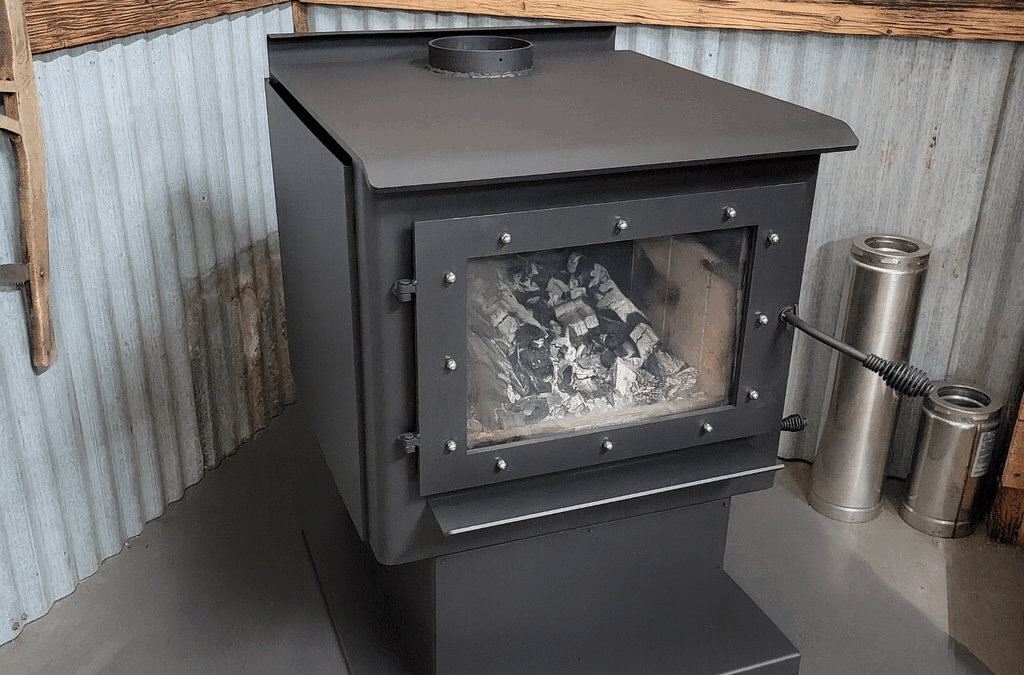
Weighing in at 120 lbs, the Caboose is our most compact wood stove, specifically engineered for spaces between 200 and 600 square feet. We’ve seen these installed in everything from horse trailers to luxury off-grid yurts.
What sets the Caboose apart is its versatility. We offer a wall-mount option that saves precious floor space: a commodity that’s hard to find in a van. Like its bigger brothers, it’s handcrafted in Idaho from thick American steel. It features a glass viewing window so you can actually enjoy the fire, and it’s built to withstand the vibrations of life on the road. If you’re looking for a tiny wood stove that won’t burn your house (or van) down, this is it.
Why “Made in Idaho” Still Matters
We get asked all the time why we don’t outsource our manufacturing to bring the costs down. The answer is simple: we couldn’t sleep at night.
When you buy a Flame Innovation stove, you’re buying something that was hand-welded by a certified craftsman right here in Idaho. We use American steel because it’s consistent and durable. We use brick-lined fireboxes because they protect the steel and increase efficiency.
Every stove that leaves our shop is a reflection of our family’s reputation. We don’t build “disposable” appliances. We build heirlooms. We want your grandkids to be using the same Chinook or Steelhead forty years from now. You just can’t get that kind of longevity out of a mass-produced unit with a “made in elsewhere” sticker on the back.

Honesty Time: Is a Mechanical Stove Right for You?
We’ll be the first to tell you that our stoves aren’t for everyone. If you want a stove that you can control with an app on your smartphone while you’re at the grocery store, we aren’t your guys.
Our stoves require a little bit of “firemanship.” You have to learn how your chimney draws, how your wood species burns, and how to adjust the manual dampers to get that perfect secondary burn. There’s a learning curve, and we’re okay with that.
But if you want the peace of mind that comes with knowing your heat source will work whether the sun is shining or the world is ending, mechanical is the only way to go. There is a deep, primal satisfaction in mastering a fire without the help of a computer chip.
Keep It Simple, Keep It Hot
The “smart” trend is likely here to stay in the appliance world, but we’re planting our flag in the dirt of mechanical mastery. We believe in the reliability of steel, the efficiency of the VCV system, and the value of a handcrafted American product.
Whether you’re heating a 2,000 sq ft farmhouse with the Chinook, a cozy cabin with the Steelhead, or a nomadic van with the Caboose, you’re getting a stove that was built to outlast the trends.
Ready to upgrade your off-grid setup? You can browse our full shop here. We even offer Klarna financing to make it easier to get the warmth you need without breaking the bank upfront.
Don’t let a circuit board decide if your family stays warm this winter. Go mechanical. Go Flame Innovation.